

Two summers ago a friend paid cash for a bargain tint job on his truck. By the following spring the rear glass had turned purple, the edges had peeled into little flags, and the shop had stopped answering its phone. He ended up paying twice: once for the bad film, once for the removal and redo.
That story is why the shop matters more than the film brand on the box. Anybody with a heat gun and a squeegee can slap vinyl on a window. Getting film that stays flat, adhesive that holds through a Michigan winter, and a warranty that means something takes a real operation. If you’re anywhere near southwest Michigan, a place like Auto Trim Group Kalamazoo MI is the kind of shop worth comparing others against, because it has been doing this work locally since the 1970s rather than popping up after a trend.
Below is the checklist I’d run before handing anyone the keys, plus the specific things I’d look at during the estimate.
What actually separates a good tint shop from a cheap one
Film quality is the easy part to judge, and it’s the part most buyers fixate on. Ask what brand of film goes on the glass and whether it’s a dyed, metalized, or ceramic build. Dyed film is the cheap stuff that fades. Ceramic costs more and handles heat better. But here’s my stance: a great installer using mid-tier film beats a sloppy installer using the best film on the market, every single time.
Installation is where jobs live or die. Dust trapped under the film, blades nicked into a defroster line, rubber gaskets sliced during trimming, and film cut short of the edge so it peels within months. None of that shows up in a price quote. All of it shows up 18 months later.
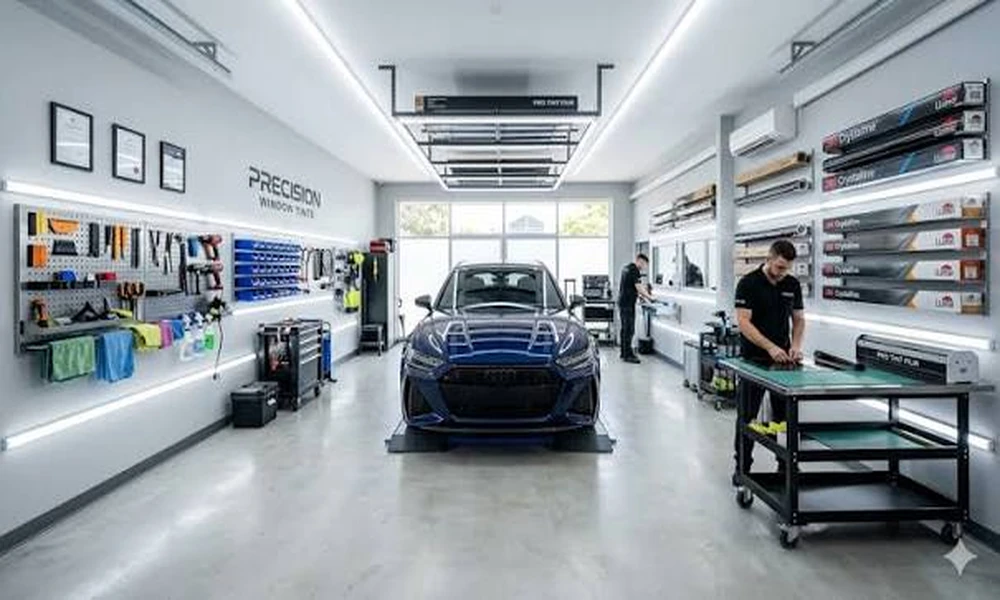
So look at the bay, not the showroom. Is it enclosed? Is the floor swept? Do the installers work under controlled lighting, or is the car sitting in an open lot with pollen blowing around? A clean, sealed bay tells you more about your future windshield than any brochure.
The questions I’d ask before signing anything
Walk in with four questions and listen to how the answers land. Vague answers are your signal to leave.
- What is the film’s manufacturer warranty, and does it cover color shift and bubbling, not just peeling?
- Is the install done indoors, and how long does the vehicle stay in the bay?
- What happens if I find a defect in the first month, and who pays for removal?
- Can I see a vehicle you finished last week, not last year?
The warranty question matters more than people think. A shop that stands behind its work will name the film maker and hand you paperwork. A shop that shrugs and says “we’ll take care of you” is offering a handshake, not a guarantee.
Window tint rules you should know before you pick a shade
Every state sets its own limits on how dark your front side windows can be, and the rules change from year to year. Michigan is more permissive than most, but the specifics are worth confirming with the agency that handles vehicle code in your state before you commit to a percentage.
There’s also a practical reason to think about heat, not just looks. The Department of Energy has long noted that solar gain through glass is a meaningful driver of cabin heat, which is exactly why ceramic film earns its price on a black truck with black leather. You don’t need a physics lecture. You need to know that the cheapest film often means the hottest cabin in July.
Wraps and graphics: the prep is the product
Vinyl wraps fail for one reason almost every time, and it isn’t the vinyl. It’s the surface underneath. Paint has to be cleaned, decontaminated, and often corrected before any film touches it, because a wrap locks in whatever is on the panel. Swirl marks, tar, old wax residue: all of it goes under the vinyl and stays there.
Ask how the shop preps. If the answer is “we wipe it down,” walk. If the answer involves a clay process, an IPA wipe, and a conversation about whether your clear coat has any chips that need attention first, you’re talking to someone who does this properly.
I’d also push back on anyone quoting a full wrap over the phone without seeing the vehicle. Curves, trim, badges, and door handles drive labor. A quote without an inspection is a guess dressed up as a price.
A quick vetting checklist you can run in one visit
Here’s the walkthrough I’d use. It takes maybe 15 minutes and saves months of regret.
- Ask for the film or vinyl brand by name and write it down.
- Look at the installation bay. Enclosed, clean, lit.
- Request one recent customer reference you can actually call.
- Confirm the warranty in writing, including the removal clause.
- Check whether they do removal and redo work at all, since a shop that only installs may not have the skill to fix someone else’s mess.
- Ask how they handle defroster lines and rear glass, which is the hardest surface on any vehicle.
That last point separates the pros. Rear glass has curvature, a defroster grid, and often a third brake light housing nearby. One wrong blade stroke and you’re looking at a grid repair, which is not cheap and not always fixable.
Reading the shop’s history without getting snowed
Longevity isn’t a guarantee of quality, but it’s a useful filter. Businesses that survive decades in a small market tend to do so because repeat customers keep showing up. The Small Business Administration tracks survival data for new businesses, and the pattern is clear: most don’t make it far past the first few years. So when a shop tells you it has operated in the same city for generations, that’s a data point in its favor, not just a marketing line.
You can also do a quiet check on the shop’s reputation by looking at how long its web presence has existed. The Internet Archive keeps snapshots of websites going back years, and a shop with a consistent footprint across a decade is one that has kept its doors open and its name intact.
The one I’d pick
If I were choosing for my own vehicle, I’d pick the shop that answers the warranty question first and the price question second. Price is the easiest thing to compare and the least useful. Labor, prep, and follow-through are what you actually buy.
And I’d rather pay 20 percent more at a shop that has done this for a long time in the same town than save a few hundred bucks at a place that might not be there when the film starts to fail. There’s no award for being the cheapest tint job in the county, and there’s no dignity in explaining to your spouse why the rear window looks like a raisin.
So do the walkthrough. Ask the four questions. Look at the bay. Then decide. If a shop can’t handle those basics, the price was never the point. What’s the last thing you bought on price alone that you ended up replacing within a year?
